
How to Implement Profit First in Your Australian Business


You're working hard, so where does all the money go?
If you've ever looked at a busy month and wondered why your bank account doesn't reflect it, you're not alone. Thousands of Australian small business owners run profitable businesses on paper but feel broke in practice. Revenue comes in, expenses go out, and profit, if there's any left, is an afterthought.
Profit First changes that. It's a cash management system created by Mike Michalowicz that flips the traditional accounting formula on its head.
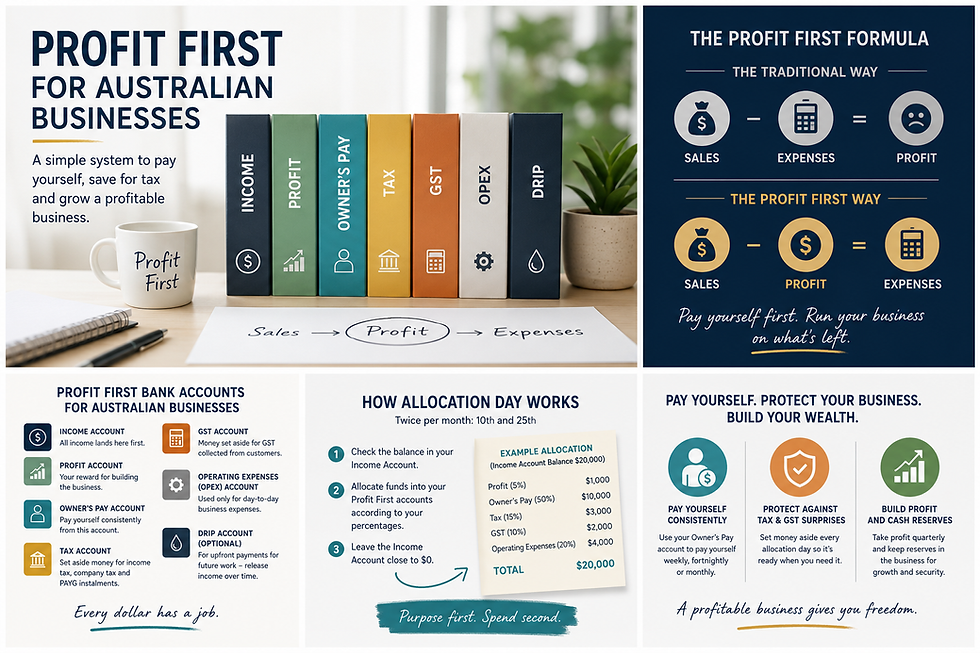
Instead of Sales − Expenses = Profit, you operate by Sales − Profit = Expenses.
You take your profit first, every single time money comes in, and run the rest of your business on what remains.
In this guide, I'll walk you through exactly how to implement Profit First in your Australian business, including bank accounts you'll need, how allocations work, and where to start even if your cash flow feels tight right now.
Why the Traditional Approach Keeps Business Owners Broke
Most business owners manage money the same way: revenue lands in one account, bills get paid, and whatever's left is considered profit. The problem? Parkinson's Law. Supply creates its own demand. When money is available, we spend it. When one account holds everything, everything gets spent.
This isn't a character flaw. It's human nature. And Profit First works precisely because it works with that nature rather than against it. By separating money into purpose-named accounts, you remove the temptation and create built-in discipline.
As Mike Michalowicz puts it: 'Profit is not an event. Profit is a habit.' That's the heart of the system.
The Five Accounts You Need
Profit First runs on five foundational bank accounts. Each dollar has a job, and money only moves between them in deliberate, planned ways.
1. Income
Every dollar of revenue lands here first. This is a holding account; nothing gets paid directly from it. Think of it as the post office: mail arrives here, then gets sorted and sent to the right place.
2. Profit
This is your reward for taking the risk of running a business. Money accumulates here and is distributed quarterly as a real, tangible reward rather than ploughed back into the business. If this account has always been empty, that's about to change.
3. Owner's Pay
Separate from profit, this is the wage you pay yourself for the work you do in the business. Many Australian business owners forget to pay themselves properly. This account fixes that.
4. Tax
The ATO is your silent business partner; they get their cut regardless. This account is where you set aside money for GST, income tax, and PAYG. No more BAS surprises. No more scrambling at EOFY. The money is already there.
5. Operating Expenses (OpEx)
Everything else, rent, software, staff wages, supplies, subscriptions, comes from here. This is the account you run your day-to-day business from. When the plate is smaller, you naturally make smarter spending decisions.
The Allocation Rhythm
Profit First works on a simple, repeatable rhythm. Twice a month, most practitioners use the 10th and 25th, you transfer the balance of your Income account into the other four accounts according to set percentages.
Those percentages are called your Current Allocation Percentages (CAPs). They reflect where your business is right now. Your Target Allocation Percentages (TAPs) are where you're heading. The transition is gradual, with small shifts of 1 – 3% each quarter, so your business adjusts without feeling squeezed.
The rhythm matters as much as the percentages. Doing it twice a month on fixed dates turns money management from a constantly anxiety-inducing task into a small, predictable habit.
What Are the Right Percentages for an Australian Business?
There's no single answer; it depends on your revenue, industry, and stage of business. Smaller businesses typically allocate more to Owner's Pay and less to OpEx. Larger businesses tend to have higher OpEx as they build teams and infrastructure.
As a rough guide: Profit sits between 5 – 20%, Owner's Pay between 30 – 50%, Tax around
15 – 20% (particularly important in Australia given GST and income tax obligations), and Operating Expenses in the 30 – 60% range.
One important note for trades businesses, agencies, and anyone who passes money through to subcontractors or materials: Profit First percentages are applied to Real Revenue, not top-line revenue.
Real Revenue = Total Revenue − Materials − Subcontractors.
This gives a true picture of the money your business can actually manage.
How to Start, Even If You Can't Afford Full Allocations
Here's the most common concern I hear: 'I can't afford to set aside profit right now.'
I understand. And here's what I tell every client: start at 1%. Set aside one per cent of every deposit into your Profit account. That's it.
One per cent won't transform your business overnight. But it will prove to yourself that profit is possible, and it will start building the habit. Once 1% feels comfortable, you nudge to 2%, then 3%. The discipline matters far more than the amount, especially in the early stages.
The Quarterly Profit Distribution
Every quarter, you take a distribution from your Profit account, typically 50% of the balance. The other 50% stays as a cash reserve.
This distribution is important. It has to feel like a reward: a holiday, a personal savings boost, something that genuinely acknowledges the risk and effort of running your business. Not ploughed back into the business, not used to cover a slow month.
When profit feels real and tangible, the motivation to protect and grow it becomes real too.
Opening the Right Accounts
In Australia, most of the major banks, Commonwealth Bank, ANZ, Westpac, and NAB, allow you to open multiple accounts under one login. You'll typically need a business transaction account for each of your five Profit First accounts.
One practical tip: open your Profit and Tax accounts at a different bank from your main business account. Out of sight, out of mind. When the temptation to dip in is removed, these accounts do their job properly.
Give each account a name that reflects its purpose. Seeing 'GST & Income Tax' in your banking app is a powerful reminder not to touch it.
A Common Myth Worth Addressing
'Profit First is just a budget.'
It isn't. A budget is a forecast, a plan you make in advance. Profit First is a cash management behaviour system. It manages real money in real time. You're not predicting what will come in and go out; you're allocating actual dollars as they arrive. That's a fundamentally different approach, and it's why it works when budgets often don't.
Your First Step Today
If all of this feels like a lot, I want to reassure you: you don't have to do everything at once. The very first step is just this: run the Instant Assessment.
The Instant Assessment is a one-page tool (available free from Mike Michalowicz's website) that compares your current numbers against the Profit First target percentages. It shows you exactly where you stand today. No judgment, just clarity. And from that clarity, a plan.
If you'd like help setting up Profit First for your business, I work with Perth business owners as a Certified Profit First Professional. We can do the Instant Assessment together and build a roadmap that fits your numbers and your situation. Feel free to reach out. I'd love to help you get started.
Key Takeaways
Profit First flips the formula: take profit first, run the business on what remains.
Five accounts give every dollar a job: Income, Profit, Owner's Pay, Tax, and OpEx.
Allocations happen twice a month (10th and 25th) - a small, repeatable rhythm.
Start at 1% profit if you're not sure you can afford it. The habit matters more than the amount.
Australian businesses should quarantine GST and income tax in the Tax account to avoid ATO surprises.
The Instant Assessment is the right starting point; it shows you where you are before you plan where to go.


Comments